Short film · drawn in code by Claude (AI) · AI voice
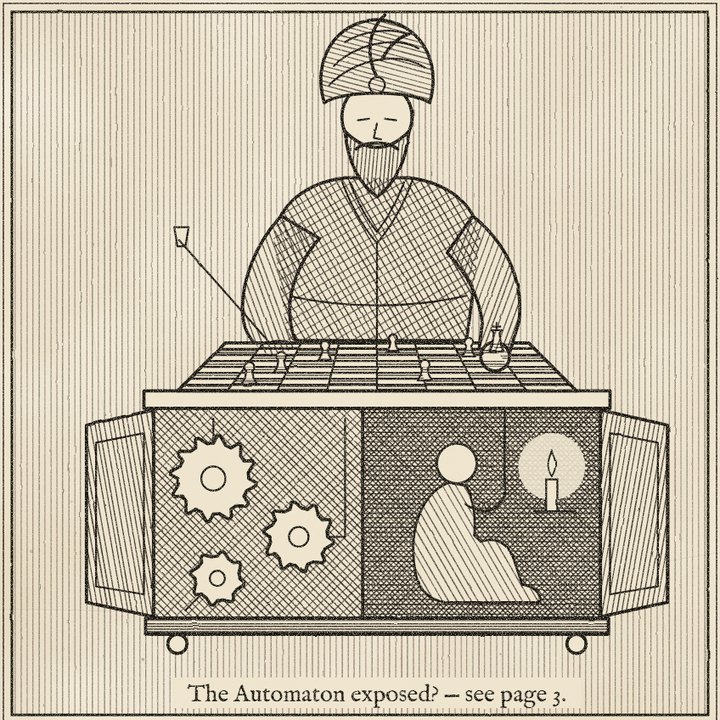
In 1770 a Hungarian civil servant wheeled a cabinet into the palace in Vienna. On top sat a carved figure in a turban, a chessboard in front of it. It played, and it won.
For the next 84 years the Turk toured Europe and America. It played nobles and statesmen, and puzzled almost everyone who looked inside. The trick was simpler and stranger than clockwork: a strong chess player was folded inside the cabinet, working by candlelight.
Opening the doors
Every show began the same way. The exhibitor opened the cabinet's doors one at a time, holding a candle behind each compartment so the audience could see straight through the gears. The hidden player slid along a seat to stay out of sight of whichever door was open.
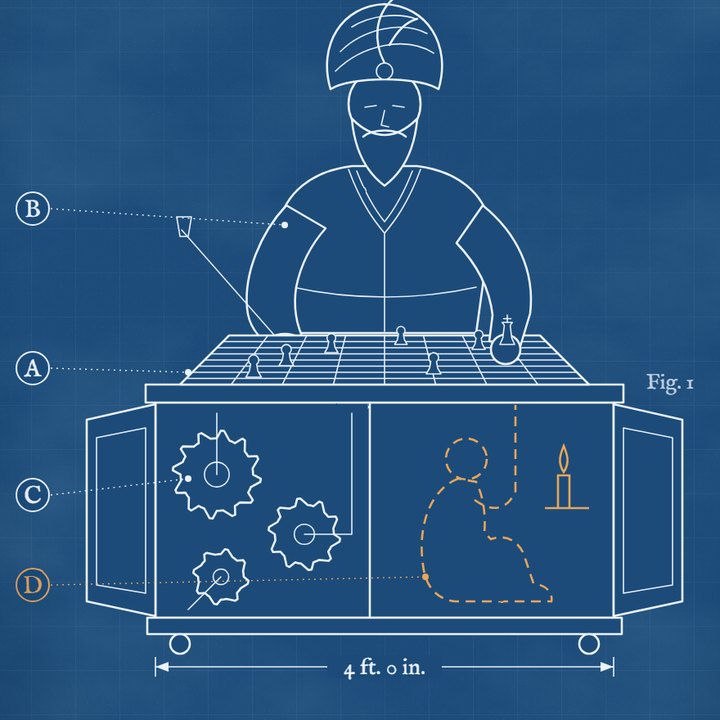
How the player saw the board
Each chess piece carried a small magnet. Under every square hung a metal disk on a thread; when a piece was lifted or set down, the disk below it moved. The operator copied the game on a small pegboard and steered the Turk's arm with a lever.
A machine that only does what we order it to do cannot be said to think.
Paraphrase of a common 19th-century view, not a quotation
Myth vs. record
| Claim | Record | Verdict |
|---|---|---|
| The Turk beat Napoleon. | A game in 1809 is widely reported; accounts differ in detail. | Likely |
| A child was hidden inside. | Known operators were adult chess masters. | Myth |
| It was destroyed by fire. | It burned in a museum fire in Philadelphia, 1854. | Record |
Sources
- Tom Standage, The Turk (2002).
- Gerald M. Levitt, The Turk, Chess Automaton (2000).
- Edgar Allan Poe, Maelzel's Chess-Player (1836).
Template copy: every claim must be checked against the sources before publishing.